If you’re an Airbnb host relying 100% on OTAs (Online Travel Agencies) like Airbnb, Vrbo, or Booking.com, you’re leaving money and long‑term control on the table. A direct booking website is your single best lever to boost profit, reduce platform dependence, and build a brand guests come back to.
As a web developer who builds high-converting websites for business owners, I’ve seen hosts go from “Airbnb-only” to a balanced strategy that keeps calendars full while saving thousands in fees. This guide breaks down why a direct booking site matters, how to make it work, and what tech to use without creating a second full-time job for yourself.
What is a direct booking website?
A direct booking website is your own property site where guests can:
- View your listings with high-quality photos, details, availability, and pricing
- Check live calendars and book instantly
- Pay securely with credit card or Apple/Google Pay
- Agree to your terms, house rules, and deposits
- Receive automated confirmations and pre-arrival messages
It typically connects to your Property Management System (PMS) or booking engine so it stays synced with Airbnb, Vrbo, and other channels. That means no double bookings and no manual juggling.
Top advantages of having your own direct booking site
- Keep more of your revenue
- OTA fees typically range 10–20% per booking (varies by platform and plan).
- Example: If you do $80,000/year in bookings at 15% fees, that’s $12,000 in fees.
- Even shifting 25–40% of your bookings direct can save thousands annually and pay for your site many times over.
- Own the guest relationship
- Build your email list and nurture repeat stays.
- Send special offers, last-minute availability, and seasonal packages.
- Guests become yours, not Airbnb’s, so you’re not starting from zero every time.
- Control your brand and policies
- Present your properties the way they deserve better copy, better photos, video tours, unique selling points.
- Set your own cancellation policy, deposits, add-ons, and upsells.
- Offer book-direct perks (late checkout, welcome gift, earlier check-in).
- Diversify and de-risk
- Platforms change algorithms, fee structures, and rules. Your site is a buffer against sudden shifts.
- If an OTA account gets paused or a listing drops in search, your bookings don’t disappear overnight.
- Flexible pricing and upsells
- Create multi-night discounts, early-bird specials, and add-ons like airport transfers, gear rentals, pet fees, or mid-stay cleans.
- Increase average order value while giving guests more choice.
- Better SEO and local visibility
- Rank in Google for “[City] vacation rental,” “family-friendly stays in [Neighborhood],” or niche keywords (pet-friendly, hot tub, near hospital/campus).
- Show up in Google Business Profile and Google Maps; where guests start their search.
- Build a salable asset
- A brand, a site, and a guest database increases the value of your business if you ever sell.
OTA only vs. OTA + Direct booking
| Strategy | Pros | Cons |
|---|---|---|
| OTA only | Instant visibility, built-in trust, simple to start | High fees, no guest ownership, platform dependence, limited brand control |
| OTA + Direct | Lower fees on direct bookings, email list + repeat stays, brand control, resilience | Requires a proper site setup and ongoing marketing (manageable with the right stack) |
What you need to make direct bookings work
- A modern, fast website: Mobile-first, fast load times (Core Web Vitals), beautiful photos, clear copy, and an easy booking flow.
- A booking engine/PMS with channel management:
- Sync calendars and rates with Airbnb/Vrbo to prevent double bookings.
- Accept secure payments and send automated communications.
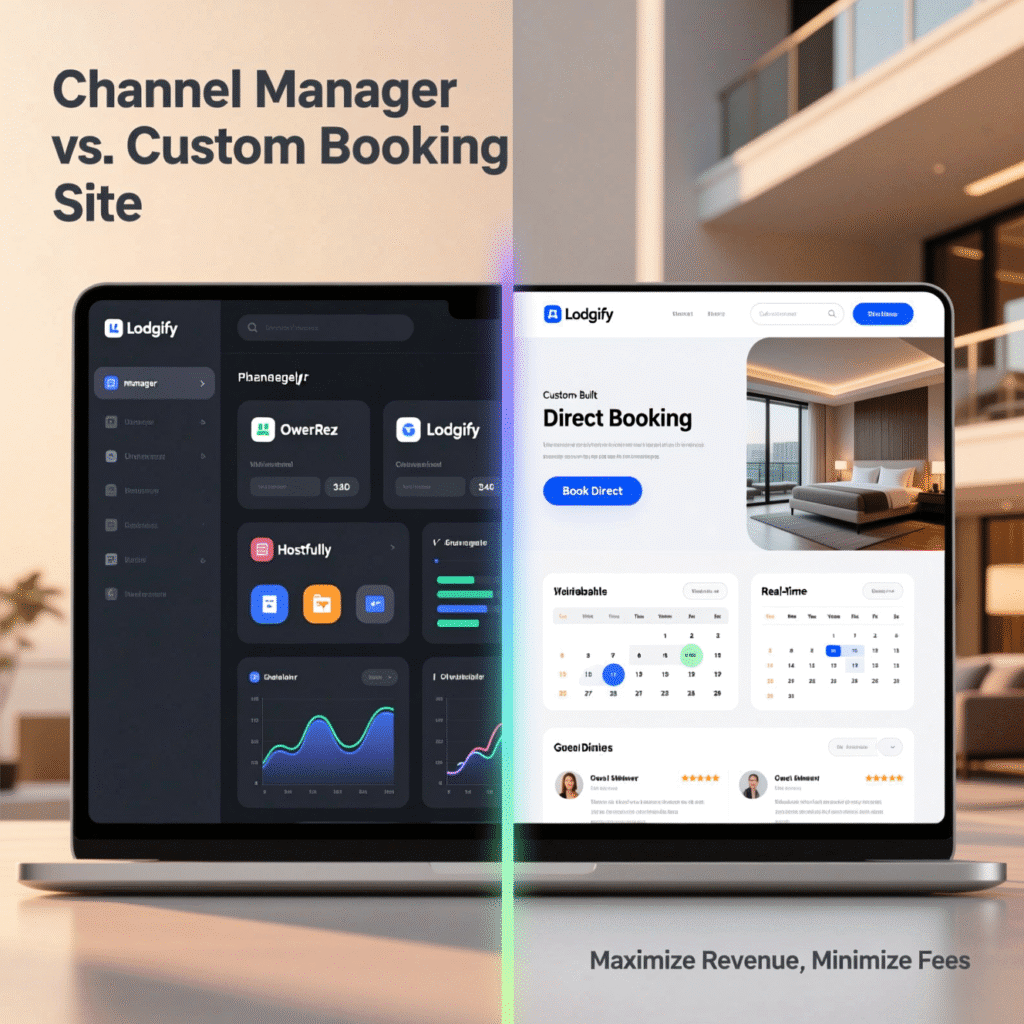
- Popular options for hosts: Lodgify, OwnerRez, Uplisting, Hospitable, Hostaway, Hostfully.
- Payment processing: Stripe, Square, or your PMS’s built-in processor for PCI-compliant payments and deposits.
- Dynamic pricing: Pricelabs, Beyond, or Wheelhouse to keep rates competitive and maximize revenue.
- Trust and safety:
- Clear policies, visible house rules, and transparent fees.
- Optional ID verification, deposit/waiver, and rental agreement (via Superhog, Autohost, or PMS features).
- Legal and compliance:
- SSL certificate, privacy policy, terms, cancellation and refund policy.
- Local tax collection and remittance (configured in your PMS).
- Accessibility basics (alt text, color contrast, keyboard navigation).
- Respect OTA terms, don’t try to move active inquiries off-platform.
- Analytics and tracking: GA4, Google Tag Manager, Meta Pixel, conversions set up on the checkout/thank-you pages.
Conversion essentials for your direct booking site
- Clear value proposition above the fold: What makes your stay special? Location, amenities, unique design, pet-friendly, parking, EV charger, etc.
- High-quality visuals: Professional photos, short video or 3D tour help guests “feel” the stay.
- Frictionless booking:
- Availability calendar visible early
- “Reserve” button always on screen (sticky CTA)
- Streamlined checkout with Apple/Google Pay
- Rate parity + book-direct perks:
- Keep base rates consistent with OTAs to maintain fairness.
- Offer small exclusive perks for booking direct (5% off, free early check-in when available, welcome gift).
- Social proof and trust:
- Reviews from past guests (import/aggregate where permitted).
- Logos of press features or local partners.
- Clear, human cancellation and house rules.
- Reduce uncertainty:
- Accurate location context, parking details, noise expectations, Wi-Fi speed, bed sizes.
- Transparent fees and taxes; no surprises.
- Gentle urgency:
- “Only 2 weekends left this month” or “4 people are viewing these dates” (honestly implemented).
- Support:
- Live chat or fast contact options.
- Rich FAQ for common questions (pets, events, early check-in, luggage drop).
Marketing your direct booking engine
- SEO fundamentals:
- Optimize property pages for “[City] vacation rental with [amenity].”
- Publish helpful local content: neighborhood guides, seasonal events, “best of” lists.
- Implement schema markup (VacationRental or Hotel schema) for rich results.
- Google Business Profile:
- Add your brand/site, post updates, collect reviews (from direct guests).
- Ensure NAP consistency across directories.
- Google Vacation Rentals (GVR):
- Many PMS solutions can feed your listings into GVR for extra visibility.
- Email marketing:
- Collect emails pre-stay and post-stay.
- Automate post-stay “thank you” with a direct-booking discount for next time.
- Segment by season or interest (families, remote workers, pet owners).
- Retargeting ads:
- Use Meta/Google remarketing to bring back site visitors who didn’t book.
- Promote special dates and shoulder-season deals.
- Social + creator partnerships:
- Short-form video walkthroughs on TikTok/Reels.
- Partner with local businesses (wine tastings, tours) and bundle packages.
- Local partnerships:
- Hospitals, universities, wedding venues, sports tournaments, and corporate travel, offer direct rates and dedicated landing pages.
Realistic ROI snapshot
Let’s say you bring in $100,000/year in bookings.
- If 30% shift to direct at a 15% average OTA fee savings, that’s $4,500 saved annually.
- Add upsells and repeat stays from your email list, and the gap widens.
- With a professional build and low monthly tooling, many hosts see full ROI within the first season.
Common questions and objections
- “Will I get double bookings?”
- Use a PMS or channel manager with instant calendar/rate sync. Test thoroughly before going live.
- “Will my Airbnb ranking suffer?”
- Keep your calendars open and performance strong. You’re diversifying channels, not abandoning OTAs.
- “Isn’t this a lot of work?”
- The right stack automates 80–90%: bookings, payments, messages, and even pricing.
- “What about Airbnb’s rules?”
- It’s fine to have a direct site and market elsewhere. Don’t move active Airbnb conversations off-platform. Build your own traffic and brand.
Recommended tech stack
- All-in-one PMS with direct site:
- Lodgify, OwnerRez, Uplisting, Hospitable, Hostaway, Hostfully
- Pros: Booking engine, channel manager, payments, automations in one place
- Cons: Monthly fee; design flexibility varies by platform
- Custom WordPress + booking engine:
- WordPress + MotoPress Hotel Booking (or similar) + Stripe + iCal/Channel Manager
- Pros: High design control, great for SEO and brand
- Cons: Needs careful setup to match PMS-level automations; best with a developer partner
Essential pages and structure
- Home: Brand promise, top properties, quick date search, trust badges
- Property pages (one per unit): Photos, amenities, live calendar, map, reviews, clear house rules
- Specials/Offers: Book-direct perks, seasonal promotions
- Area guide: Neighborhoods, restaurants, activities, events
- About: Your story, cleaning standards, sustainability, pet policy
- FAQ + Contact: Quick answers and easy contact
- Policies: Terms, cancellation, privacy, accessibility statement
Launch checklist (30-day plan)
Week 1:
- Choose PMS or booking engine and connect Stripe/Square
- Finalize brand, photos, and copy
- Map calendar sync with Airbnb/Vrbo
Week 2: - Build pages and booking flow; add policies and FAQs
- Set up GA4, Tag Manager, and conversion tracking
- Implement schema markup and performance optimizations
Week 3: - Connect Google Business Profile
- Set up dynamic pricing and book-direct perks
- Create 3–5 local blog posts or landing pages
Week 4: - QA: test booking, payments, emails, policies, mobile UX
- Turn on retargeting ads
- Announce launch on social + email list; add site to property welcome materials
A quick note on compliance and trust
- Accessibility: Alt text for images, good color contrast, keyboard navigable forms.
- Taxes and fees: Configure to auto-calculate per jurisdiction.
- Data protection: SSL, privacy policy, cookie banner where required.
- ID and damage deposits: Use your PMS or a trusted third-party tool; keep friction reasonable.
How I can help
I build high-converting direct booking websites for hosts who want to keep more revenue, own their guest relationship, and grow a brand. I can:
- Recommend and set up the right PMS/booking stack
- Design and develop a fast, beautiful, mobile-first site
- Integrate payments, messaging, dynamic pricing, and analytics
- Optimize SEO and launch campaigns to drive direct traffic
- Create automations for pre- and post-stay emails to increase repeat bookings
Want to see what this could look like for your property? Reach out and I’ll map a custom plan and transparent pricing.
Have questions about your setup, tech stack, or ROI? Tell me how many properties you manage and your average nightly rate, I’ll suggest the best path and an estimate for savings.